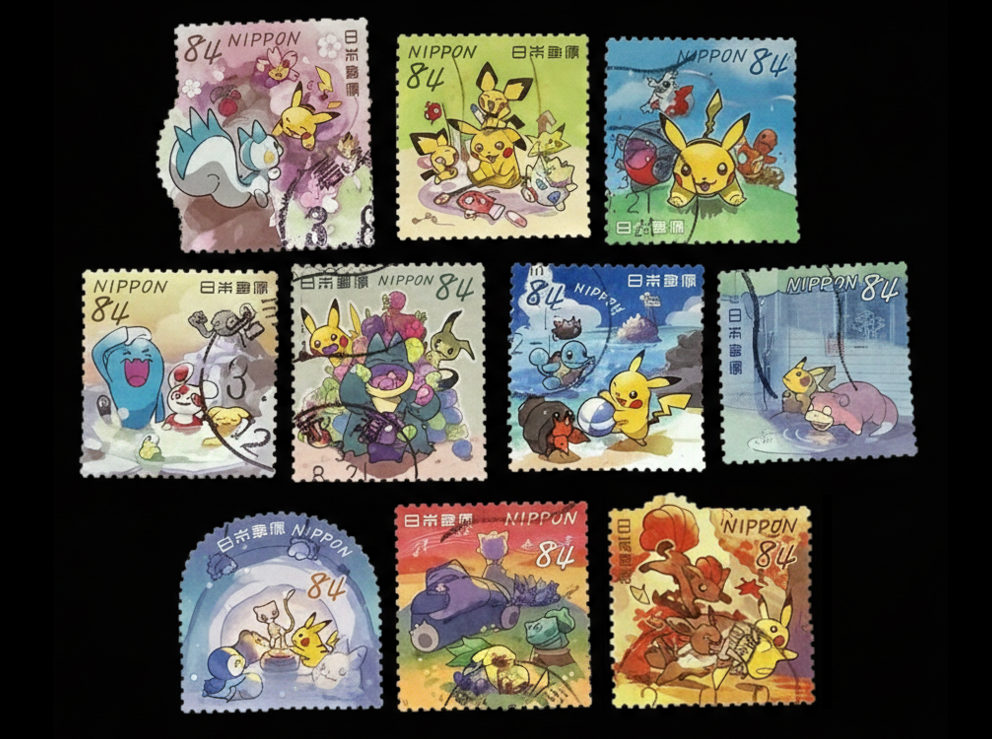
Today, the museum is proud to announce the acquisition of a new and highly significant category of artefact: a collection of official Japanese postage stamps. These are not mere stickers, but government-issued philatelic items from Japan Post, making them a unique and highly desirable piece of Pokémon history.
Artefact Details
- Artefact Name: 2021 Pokémon Stamp Collection (Used)
- Origin: Japan Post (日本郵便)
- Year: 2021
- Significance: Official philatelic items commemorating the 25th anniversary of the Pokémon Trading Card Game, featuring art based on classic cards.
Curator’s Notes
This collection of ten used 84-yen stamps is a fantastic find for several reasons. Firstly, as official postage stamps, they represent a fascinating intersection of pop culture and government recognition. The study and collection of stamps, known as philately, is a time-honoured hobby, and these pieces are a wonderful bridge between that world and the world of Pokémon. The fact that they are “postmarked” or “cancelled” adds to their story—these stamps have been on a real journey, fulfilling their purpose by carrying a letter across the real-world geological landscapes of Japan.
Most importantly for our museum, the artwork on these stamps is not random; it is a direct tribute to the history of the Pokémon TCG. Each stamp’s illustration is based on the artwork from a classic Pokémon card. For example:
- The stamp featuring Pikachu playing with a beach ball alongside Squirtle and a Dwebble is a beautiful homage to a classic beach scene.
- The stamp showing a grumpy Venusaur is a direct reference to its iconic 1996 Base Set artwork.
- The art of Pikachu and a Slowpoke fishing is taken directly from a beloved card in the 1997 Vending Machine Series—a set we have recently discussed!
This direct link to the TCG’s artistic history makes this set a perfect “Artist Feature” exhibit.
From a Geological perspective, these stamps are wonderful “Friends of Geopik.” The materials themselves—paper from wood grown in soil, and ink derived from mineral pigments—are products of the Earth. Furthermore, many of the scenes depict Pokémon in natural, geological environments: coastal beaches (erosion, sediment), icy caves (glaciology), and lush forests (the product of a stable geological foundation).